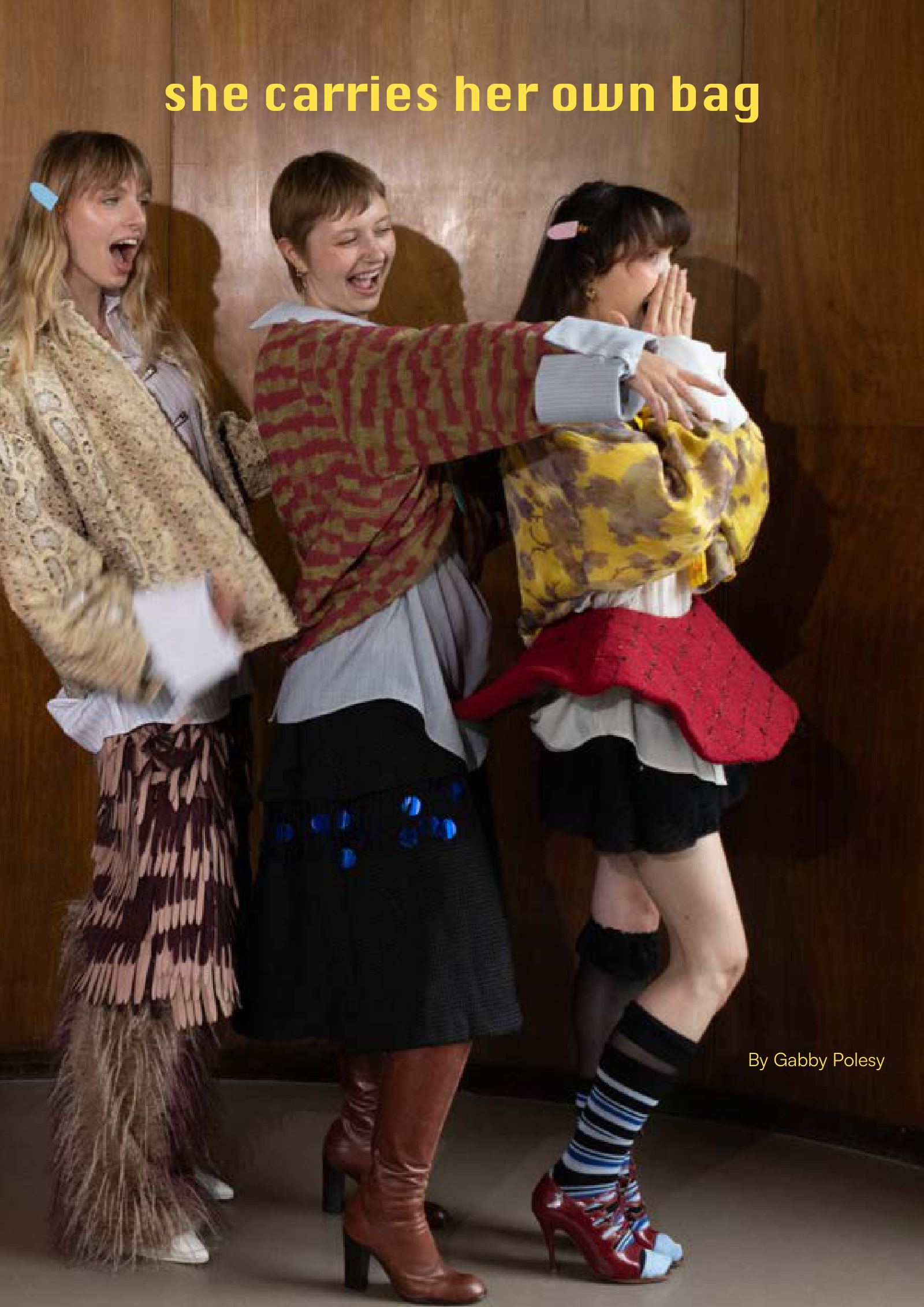
she carries her
own bag

by Gabby Polesy
Concept StatementConcept StatementConcept Statement Concept StatementConcept StatementConcept Statement

“She carries her own bag,” conveys the paradox of the female experience, existing as simultaneously hyper-visible and structurally invisible. While women’s bodies and behaviours are constantly scrutinised, the systems shaping everyday life, from workplaces to technologies to institutional standards, remain predominantly designed for the male default. In this context, visibility does not equal recognition, it signifies critique and an expectation of constant adjustment to environments that never considered women’s existence.

Inspired by Caroline Criado-Perez’s Invisible Women, the collection examines how women navigate these systemic data gaps. The process of adjustment is often normalised and framed as a universal experience, thus structural inequity remains unseen.

Consequently, femininity becomes a performative surface, required to remain visually pleasing and “agreeable” despite fundamental structural exclusion. Rather than presenting visibility as empowerment, this project explores its inherent tension and fragility. The aesthetic language merges “subversive prep” and “imperfect romance” juxtaposing softness and beauty with misalingment and disruption. Through subtle interference, contrast and intentional imbalance, the garments question the normalisation of being structurally overlooked while simultaneously following the unachievable beauty standards.

The collection is embodied by Iris, a muse who is confident, introspective and playfully observant of the systems that fail her. She carries a bag not as a accessory, but as a quiet collection of preparation. Within it are clips, ties, and small objects, tools she uses to subtly alter her clothing throughout the day, physically reshaping garments to fit a world that didn’t consider her. Iris does not move with resentment, she moves with affection and curiosity, reclaiming space through the very act of adjustment.

Challenging the paradox of hyper-visible yet structurally invisible women, this collection utilizes the items within a womens handbag to playfully disrupt the male default, transforming the hidden labor of adjustment and bringing the beauty of feminity to light which is often overlooked.
Project
Graduation Collection — Womenswear
Institution
AMFI — Amsterdam Fashion Institute
Fashion & Design, 2026
Scope
6 looks — 18 garments
My Role
Concept & research, textile and print development, pattern making, CLO3D, garment construction, art direction, graphic design & layout
Deliverables
Collection book, process document, technical drawing pack, lookbook, final presentation
Photography
Julia Schäfers
The Campaign

Six women,
one wood-panelled office

The collection photographed on location — in the corporate interior it argues with. A hundred and ten frames, shot by Julia Schäfers, art direction and styling by me. Hover to slow it down, click any frame to open it full screen.

Go to the lookbook ↓

Material Board

Snake-print jacquard fabric swatch
Look 1
Leather fringe detail
Look 3
Faux fur trim
Look 5
Jacquard detail, alternate crop
Look 2
Faux fur, alternate crop
Look 4
Leather fringe, alternate crop
Look 6
keep scrolling ↓

The Looks

explore the looks or scroll to continue
Look page
1 / 1
The Full Set

The Lookbook

Sixty-two lookbook frames, grouped look by look — shot against warm studio paper so each garment reads on its own terms, away from the office set. Photography by Julia Schäfers; art direction and styling by me.

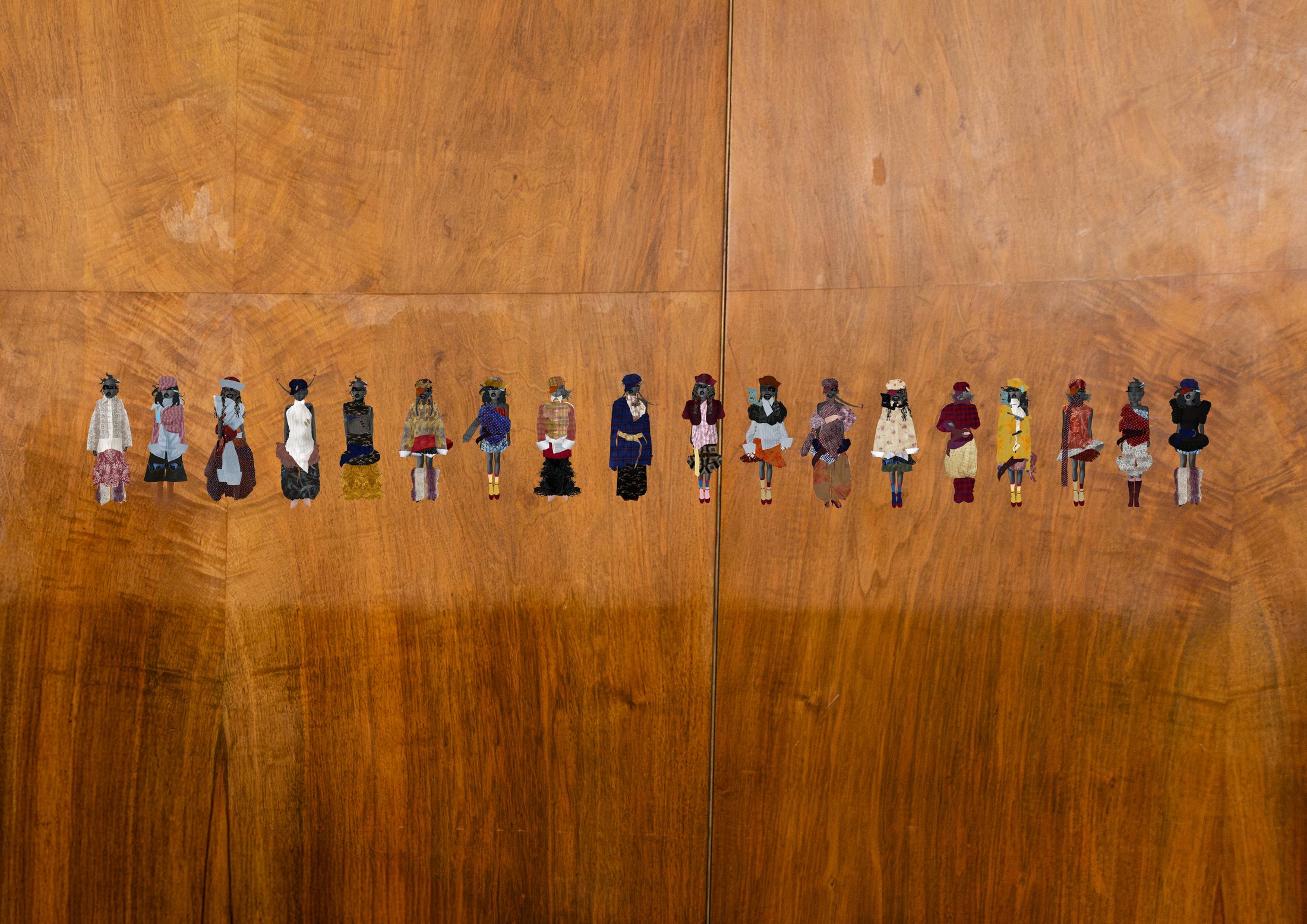
Full collection line-up against the wood wall
Final line-up — AMFI Graduation Show, June 2026
Research 01 —

What’s in
the bag?

From the historical removal of functional pockets in women’s clothing to the invention of the modern purse, women have been systematically pushed into a loop of inconvenience. We treat the handbag as a norm, but it evolved out of a lack of consideration for women’s utility.

Often dismissed as “just an accessory”, the handbag is in fact a historical marker of female autonomy. This collection turns it inside out: every clip, pin, buckle and fastening in the garments is sourced from the contents of the muse’s own bag — the hidden toolkit of daily adjustment made visible, structural, and decorative.

“It was only when handbags stopped being seen as functional and became ‘beautiful’ that people saw them as the uncontested trope of femininity.” Saumya Kalia
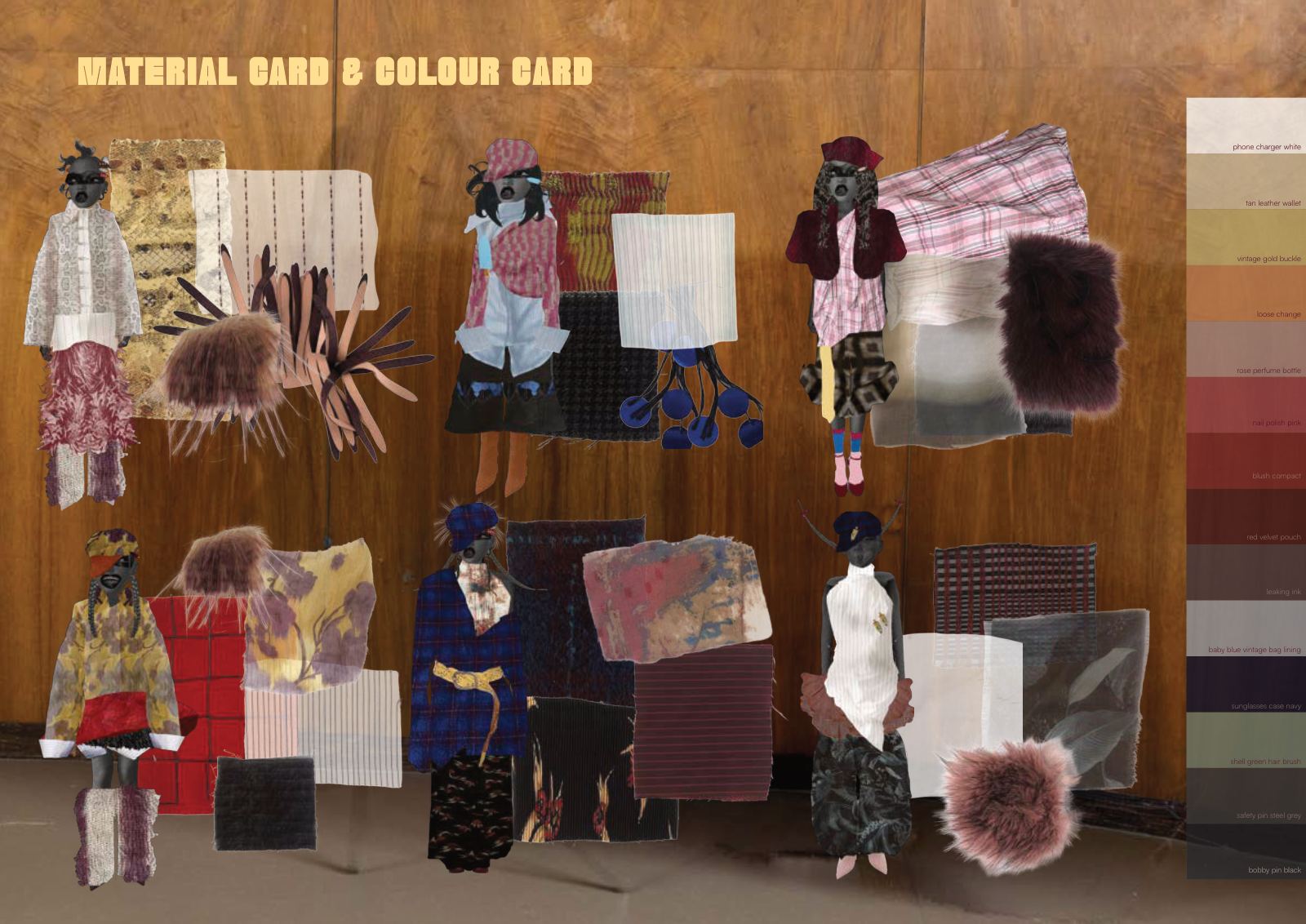
Material and colour card — objects from the handbag translated into the collection palette
Material & colour card — tan leather wallet, vintage gold buckle, rose perfume, bobby pin black, safety pin steel grey, baby blue bag lining
Research 02 — Editorial conversation

Hyper-visibility
& the male default
in STEM

Reading Caroline Criado-Perez’s Invisible Women opened the systemic side of the concept: a world designed around a male default, where women constantly reshape themselves to fit environments that treat them as an afterthought. To ground that in lived experience I sat down with Antra Johary and Marianna Piperigou Grammatika, Aerospace Engineering Master’s students at TU Delft. The full interview runs as an editorial spread inside the collection book.

Antra

“Choosing what I wear has become my way of actively challenging the STEM stereotypes. In my mind, being put together is like this weird, personal act of activism.”

Marianna

“We decided that our micro-acts of feminism are going to be dressing ourselves beautifully, wearing the makeup, wearing the heels.”

The Collection — look by look

Six looks,
eighteen garments

Each look pairs oversized corporate tailoring with hyper-feminine textiles — laser-cut fringe, hand-woven bobby-pin check, sequinned fur, dyed and digitally printed silk. Every closure is an object lifted from the handbag: hair clips replacing buttons, bobby pins woven into wool, safety pins holding a knit together.

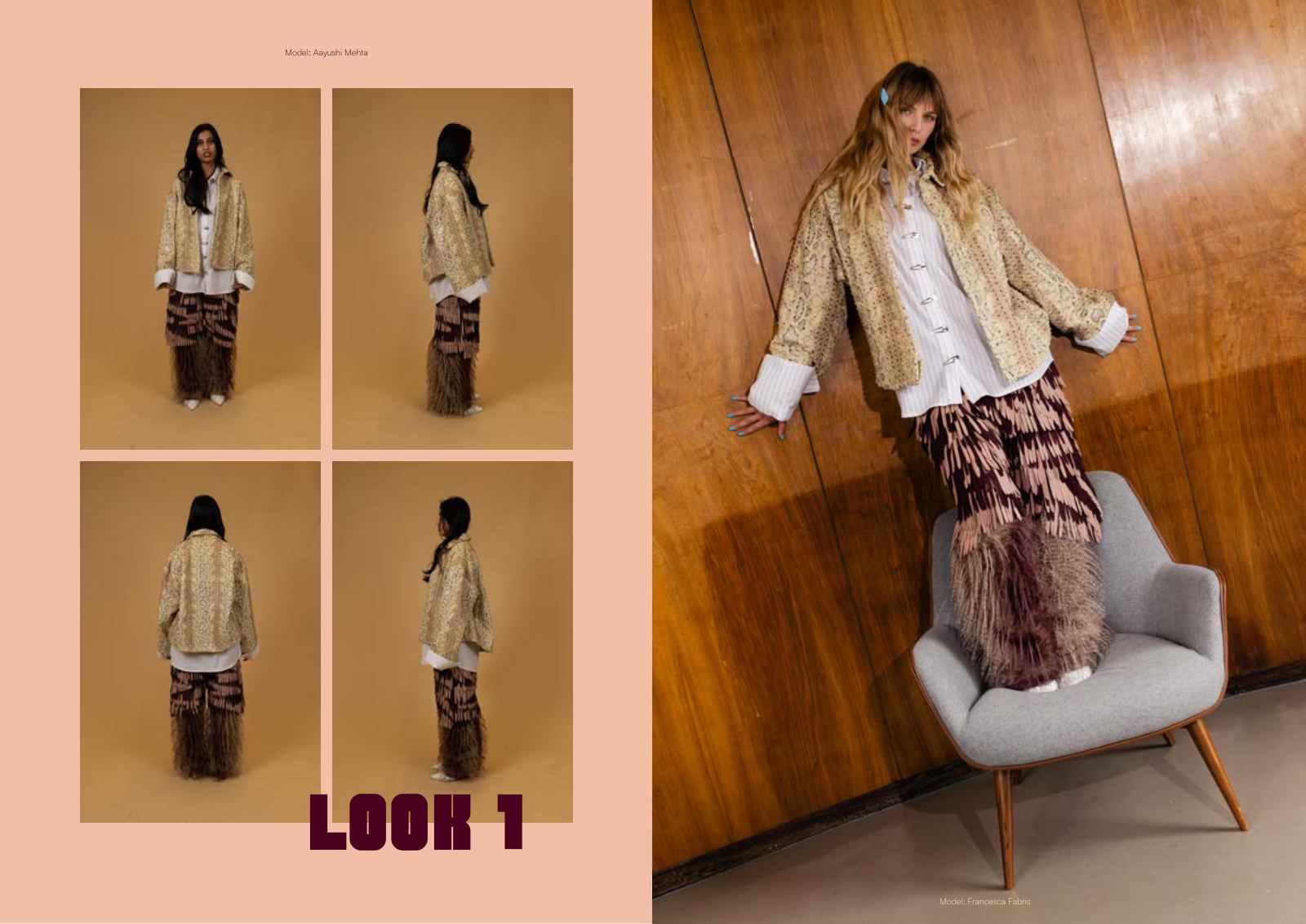
Look 1 — front, back and side views plus editorial image
01
Modelled by Aayushi Mehta & Francesca Fabris
The ShirtOversized masculine tailoring, subverted with functional hair clips sourced directly from the muse’s handbag.
The ShortsA deliberate contrast of “calm chaos” — laser-print fringed shorts in clashing tones of soft and dark pink.
The CoatSnakeskin canvas printed material, adding further contrast to the look.
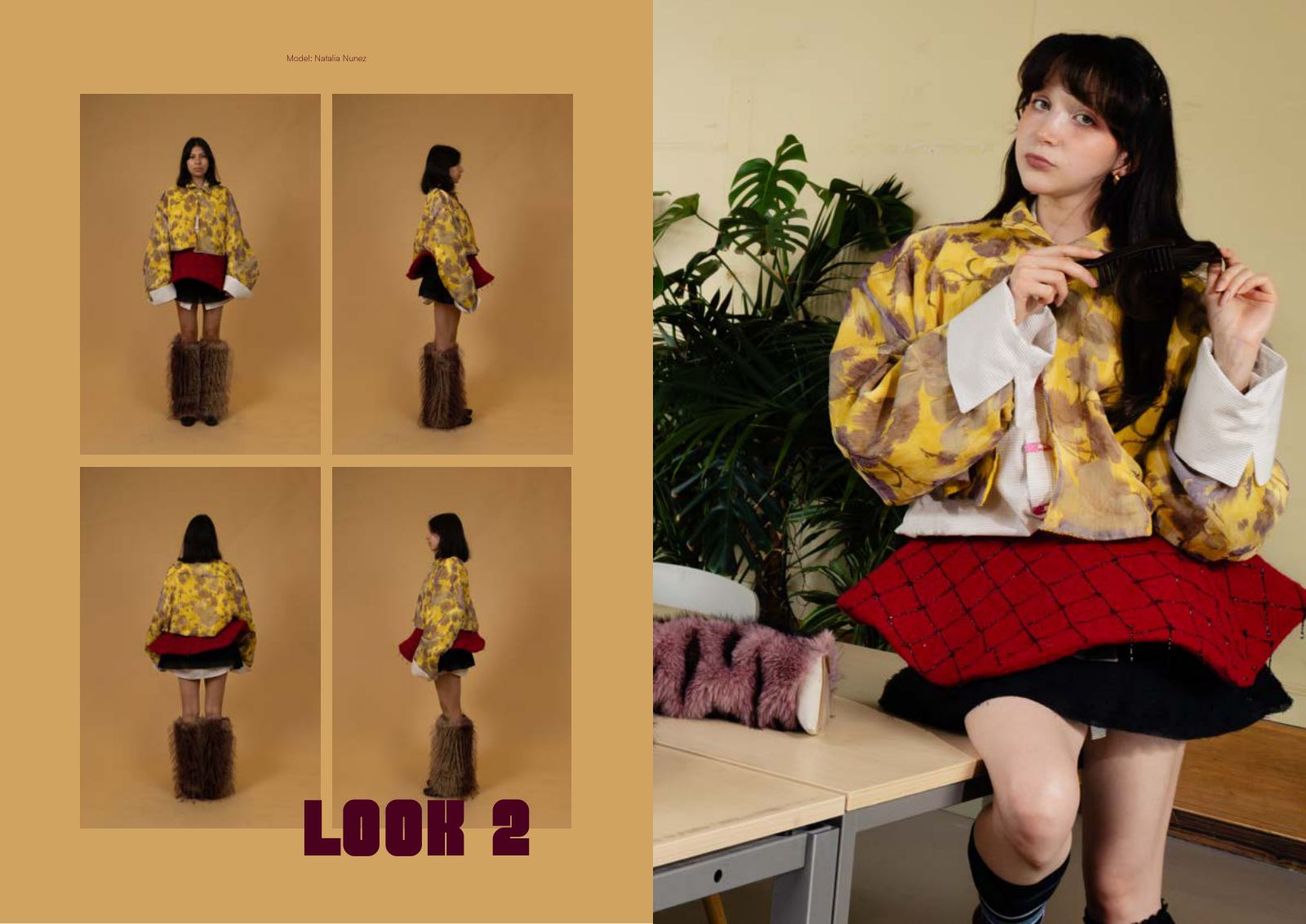
Look 2 — front, back and side views plus editorial image
02
Modelled by Natalia Nunez & Mina Petrova
The CoatA bright yellow floral jacket in soft, sheer, romantic silk, lined with a corporate checkpoint fabric — friction between expected femininity and systemic structure.
The ShirtOversized masculine tailoring, subverted with functional hair clips from the muse’s handbag.
The SkirtA heavy wool, crafted and woven with bobby pins straight from the handbag. The pins physically disrupt the traditional check print — a DIY, tactile reclamation of a corporate motif.
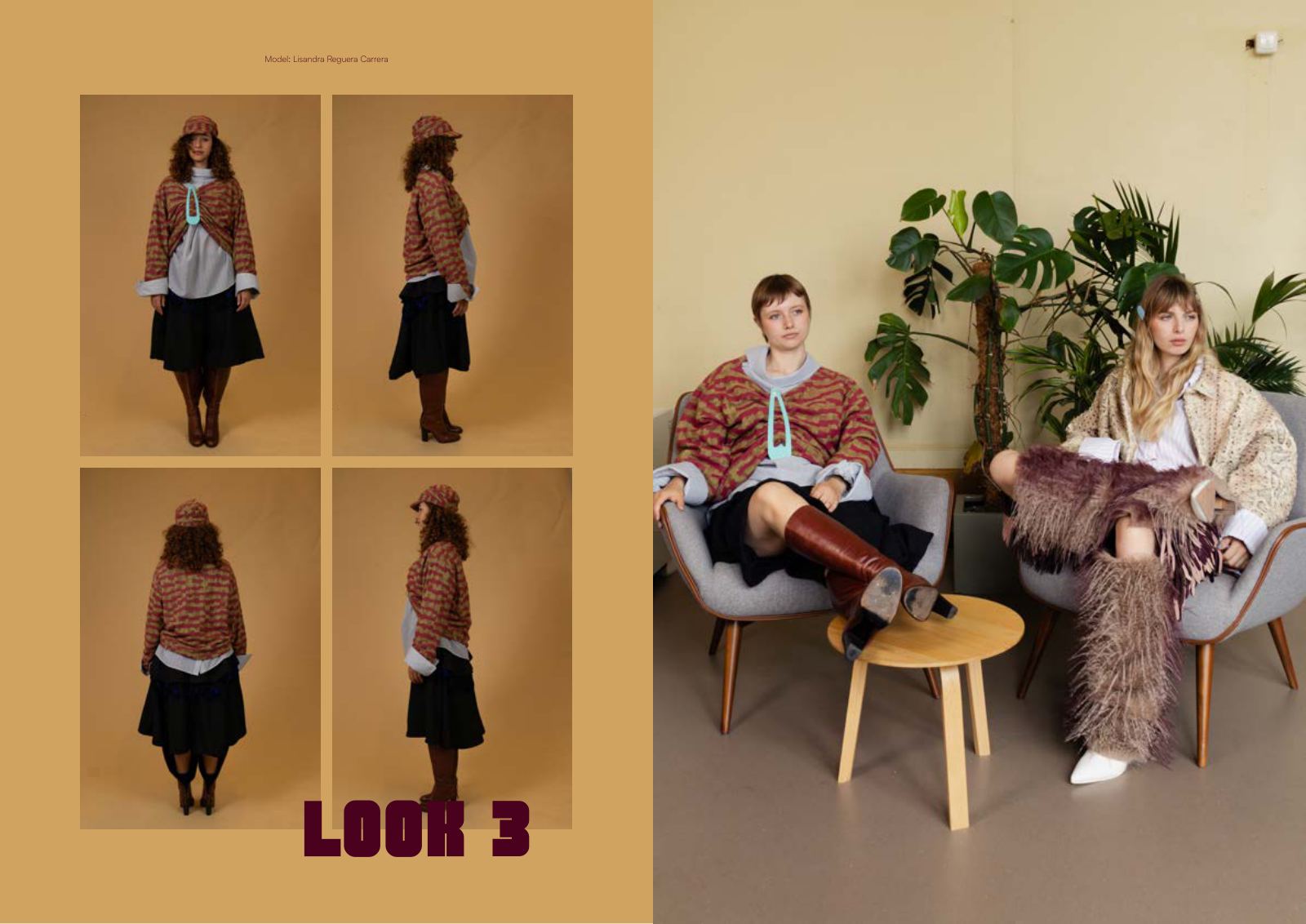
Look 3 — front, back and side views plus editorial image
03
Modelled by Lisandra Reguera Carrera & Desiree Vos
The ShirtTraditional corporate stripe print, subverted by replacing standard buttons with utilitarian bobby pins.
The ShortsMasculine check wool workwear shorts, disrupted and reclaimed with feminine fringe and sequin detailing.
The SweaterA feminine pink and green knit, physically altered and held together by a large hair clip — highlighting the constant need for women to adjust.
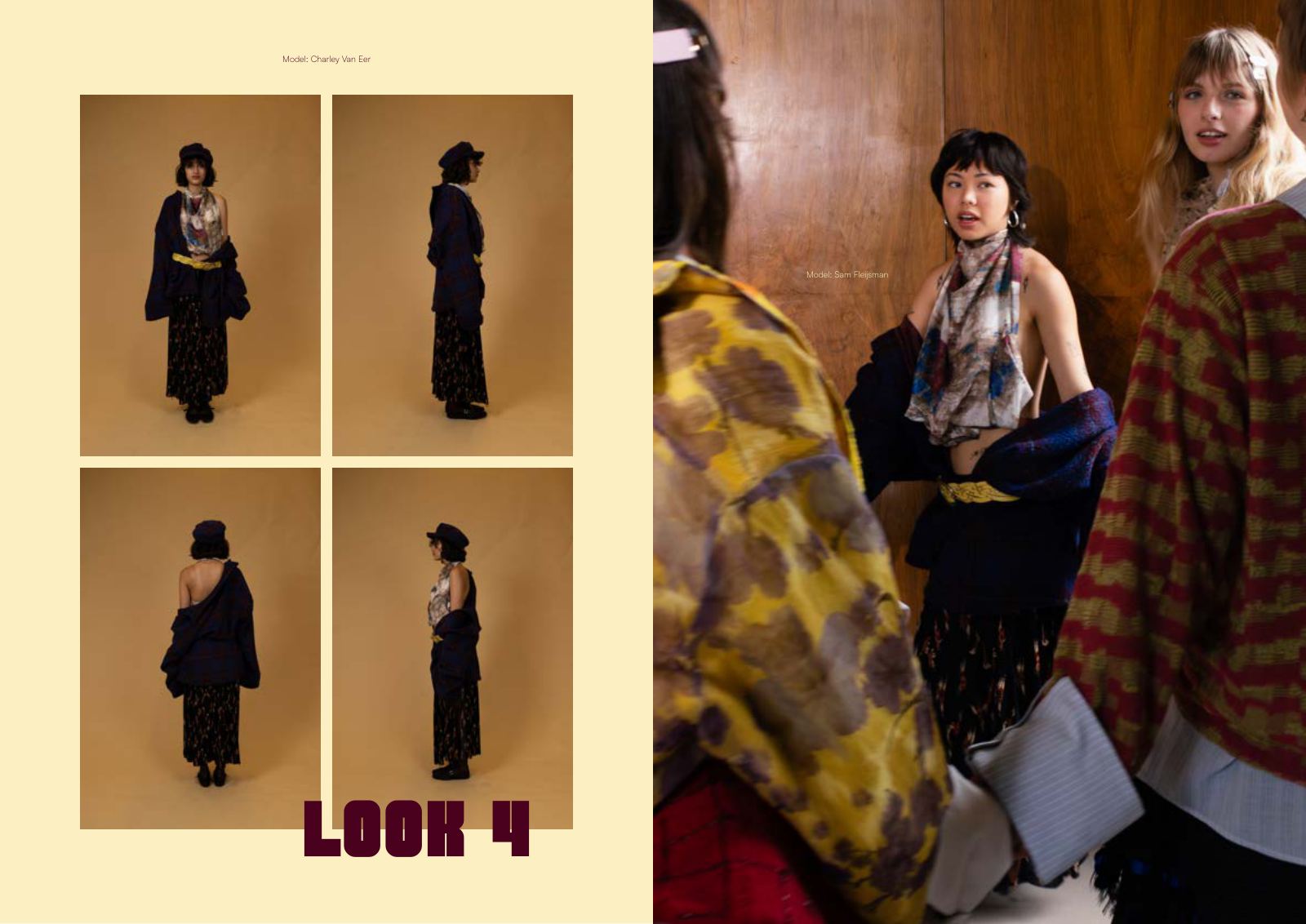
Look 4 — front, back and side views plus editorial image
04
Modelled by Charley Van Eer & Sam Fleijsman
The CoatOversized, authoritative check wool tailoring that falls off the shoulder, cinched with a belt to force an adjustment to the female frame.
The ShirtA silky, feminine print t-shirt worn completely upside down, signifying disruption and systemic misalignment.
The SkirtA romantic floral printed skirt bringing contrasting softness to the heavy, rigid tailoring above.
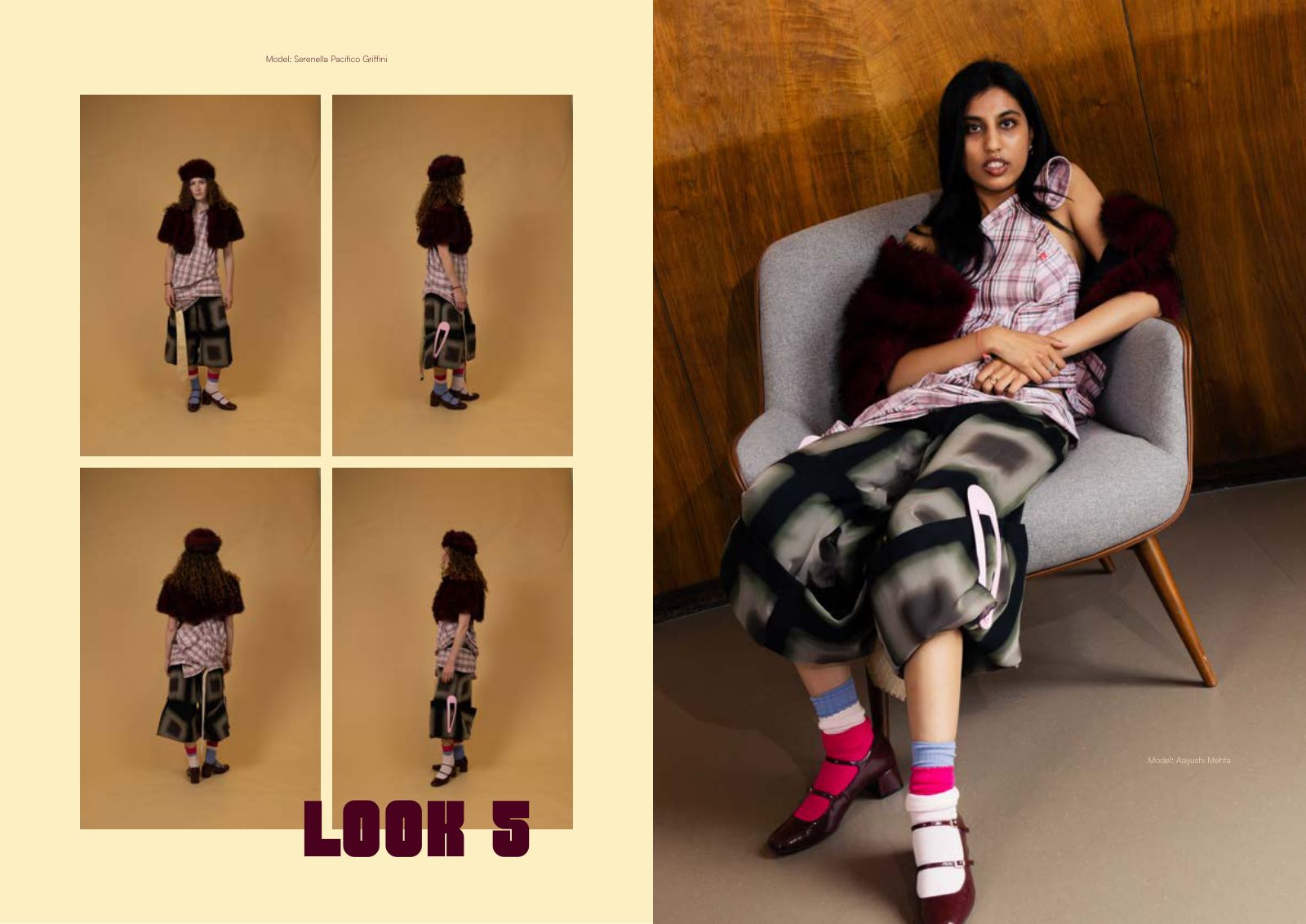
Look 5 — front, back and side views plus editorial image
05
Modelled by Serenella Pacifico Griffini & Aayushi Mehta
The ShirtAn upcycled masculine button-up reinterpreted into a one-shoulder top, with a side tie that reclaims and subverts corporate authority.
The ShawlA statement fur shawl with sequins, layering hyper-femininity and “imperfect romance” over the look.
The ShortsSilky printed shorts casually rolled at the hem — the physical adjustment made to oversized garments in an environment not designed for her.
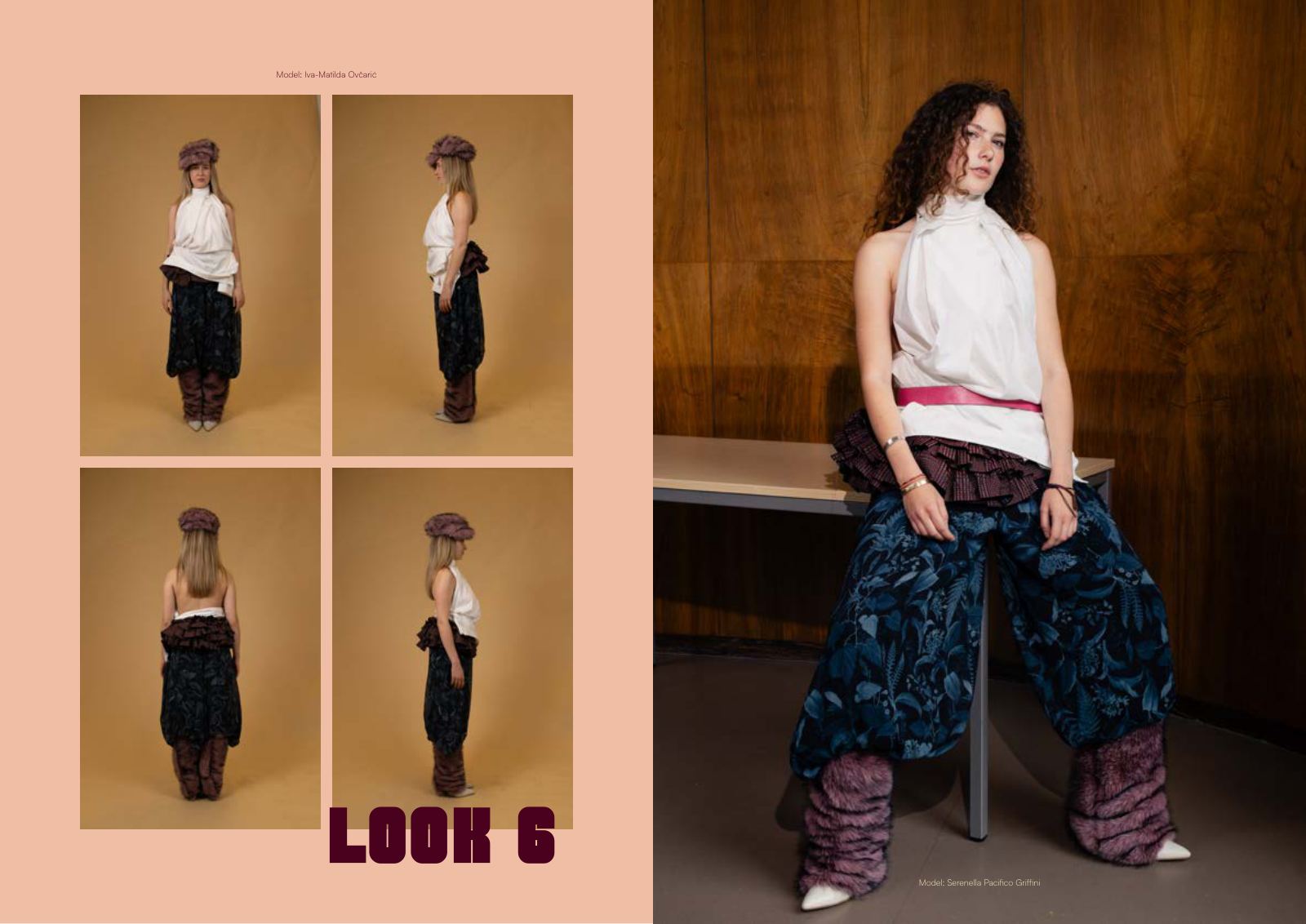
Look 6 — front, back and side views plus editorial image
06
Modelled by Iva-Matilda Ovčarić & Serenella Pacifico Griffini
The ShirtA previously made, upcycled button-up reclaimed into a high-neck silhouette that challenges standard tailoring.
The SkirtA feminine check print skirt with a raw edge and dramatic frill detailing, juxtaposing the structured check.
The PantsLong blue floral silky pants tucked into boots — the practical need to adjust and gather fabric, made deliberate.
The publication

The Collection
Book

The full 51-page collection book — designed, art-directed and laid out by me. It opens with a letter from the designer and the concept statement, moves through the handbag research and the TU Delft editorial interview, then presents the line-up, the material and colour card, and every look with its editorial imagery, process spread and technical drawings.

Cover of the She Carries Her Own Bag collection book

drag sideways — click any spread to open the book

The complete 51-page PDF, readable right here.

Prefer your own reader? Open the PDF in a new tab or download it.

Specification

Technical
Drawings

The full flat pack: front and back views for all eighteen garments, with construction callouts — blind side zippers, waistband facings, oversized sleeve plackets, collar stands, understitching, buttonholes, the layered leather fringe and the bobby-pin check print. Drawn in Illustrator alongside CLO3D mock-ups used to test volume and fit before cutting.

behind it all —

Explore the Process

A year of the project, documented spread by spread — concept building, the research into the handbag and the male default, print and textile experiments, laser cutting and 3D printing at the Makers Lab, CLO3D mock-ups, toiles, refits and the final realisation.

click any spread to read the process document

Open PDF 135 pp · 14 MB Download
The defence

Final
Presentation

The 26-slide presentation given at the final assessment — who I am as a designer, the research question, the concept, the design and realisation process, and the collection itself.

Open PDF 26 pp Download
Everything, as files

The Archive

Every document from the graduation project, in full — open in the browser or download.

Collection Book

The complete publication: designer’s letter, concept, handbag research, TU Delft editorial interview, line-up, material & colour card, all six looks with editorial imagery, process and flats.

PDF · 51 pp · 12 MB ↓

Process Document

135 spreads tracking the project from first concept building through research, textile experiments, prints, toiles, fittings and realisation.

PDF · 135 pp · 14 MB ↓

Technical Drawing Pack

Front and back flats for all eighteen garments with construction details and fabric callouts.

PDF · 19 pp · 6 MB ↓

Final Presentation

The slide deck presented at the final graduation assessment.

PDF · 26 pp · 4 MB ↓
With thanks

Credits

Design, textiles & realisation
Gabby Polesy
Photography
Julia Schäfers
Models
Aayushi Mehta
Francesca Fabris
Natalia Nunez
Mina Petrova
Lisandra Reguera Carrera
Desiree Vos
Charley Van Eer
Sam Fleijsman
Serenella Pacifico Griffini
Iva-Matilda Ovčarić
Editorial interview
Antra Johary & Marianna Piperigou Grammatika — MSc Aerospace Engineering, TU Delft
Key reading
Invisible Women — Caroline Criado-Perez
Writing on the handbag — Saumya Kalia
Tools
CLO3D · Adobe Illustrator, Photoshop & InDesign · laser cutting and digital textile printing at the AMFI Makers Lab